the ADHD Academic
  • Home
  • About
    • Glossary
    • Contact
  • ADHD
    • ADHD Fundamentals
    • ADHD in Adults
    • Misconceptions
    • Race, culture, and ADHD
    • More
  • Learning
    • Learning & ADHD blog posts
  • Teaching
    • Teaching & ADHD blog posts
  • Other bits
  • Home
  • About
    • Glossary
    • Contact
  • ADHD
    • ADHD Fundamentals
    • ADHD in Adults
    • Misconceptions
    • Race, culture, and ADHD
    • More
  • Learning
    • Learning & ADHD blog posts
  • Teaching
    • Teaching & ADHD blog posts
  • Other bits

Learning when you have ADHD

My 2023 approach to NaNoWriMo or AcWriMo

10/31/2023

2 Comments


Five sentence summary

This is my third year participating in this writing marathon, and I've learned a few things about my writing along the way. This is the first time I'm actually going to truly try to write every day. I'm counting on Shut Up & Write writing sessions, my trusty list of low focus/motivation writing tasks, sharing my progress and goals on social media, and having enough papers in progress that are of different topics to keep me interested and motivated. I'm ruling out any sort of shame as a motivator and relying on support and self-awareness instead.

What do NaNoWriMo or AcWriMo mean anyways?

So NaNoWriMo, AcWriMo, or NaAcWriMo, are all shorthand ways of referring to the month of November where folks write consistently, every day for a month. The concept of writing consistently every day didn't start in academia, but academics hopped on. Some folks write a book during this month, but others use the time to write their dissertation or submit an article in December. The main idea is to write consistently everyday.

How I made it work for me in the past

Anything that requires consistency is going to be at least a little challenging for me. As ADHD folks, we're consistently inconsistent. Knowing I would struggle at times, I made myself the most ADHD-friendly writing month ever. I've participated twice now and I definitely didn't try and write a book. I gave myself a lot of grace.

I made a goal for each day, tweeted it, and reported back. There were times I did not reach my goal, even when it was easy (by my ADHD standards easy). I would make up for the missed days the next day.

That's it. That's literally all I have done in the past.

Overall, this worked perfectly for me. I participated, I didn't feel guilty about being ADHD, and I didn't stress. It was exactly what I needed as an ADHD person trying to write consistently. (It's also what I would recommend if you're thinking of starting Academic Writing Month for the first time: lots of grace and patience with yourself!).

Read More
2 Comments

Technology to make writing easier

4/13/2023

1 Comment


Five sentence summary

Meant to be a catch-all space for tools, apps, etc. that make writing easier when you have ADHD or other conditions affecting executive functioning. Please feel free to share your own suggestions and experiences. Reference managers, more intelligent word processors, assistive technology like speech-to-text and text-to-speech, as well as tools designed for ADHD folks like Goblin.tools can all make the process of writing a little smoother.

This post is meant to be updated regularly (as regularly as my ADHD allows) to share computer applications, phone apps, websites, and other tech that can make writing easier for folks who have trouble focusing, organizing, and motivating themselves to write.

I have a table below with each technology, how it may help, as well as the types of systems the tech works with (Windows? Android phones?) and then the cost. I break down the tools more and explain how I've used them (or what I've heard). If you have suggestions for tools that have helped you with ADHD or another condition that has issues with executive functions, please let me know! I am happy to link to blogs, websites, etc. and give credit where it is due!
Technology
How it may help
System
Cost
Zotero
Lessens demands on memory, simplifies organizing, integrates with browsers to pull references. Reduces cognitive load for references and formatting.
Mac/Windows/Linux
Free!
Google Docs
Can reduce demands on memory, automatically tracks changes and edits with co-authors.
Mac/Windows/Linux
Free!
Obsidian
Integrates with many applications to reduce cognitive load, tags to help organize, ability to customize to specific needs, version control to reduce memory demands.
Mac/Windows/Linux/iPad/Android/iPhone
Free and subscription options.
Connected Papers
Visual of related ideas, reduces cognitive load for identifying connections.
Mac/Windows/Linux
3 per month free. Subscription options.
Goblin.tools
Completes many executive functioning tasks like breaking items down, estimating time of tasks, and compiling thoughts.
Mac/Windows/Linux
Free!
Microsoft read out loud
Allows for dual input (gaining info from both auditory and visual means simultaneously), it may be easier to hear a mistake if focusing on details visually is hard,
Mac/Windows
Cost of Microsoft Word.
Craft
Integrates with many applications to reduce cognitive load, tags to help organize, ability to customize to specific needs.
Windows/Mac/iPad/iPhone
Free and subscription options.
Speech-to-text
Reduce memory load, may help memory when thoughts arrive quicker than one can write/type.
Windows/Mac
Microsoft Word costs. Google Doc free option.

Read More
1 Comment

Writing tips for those who can't organize, focus, and motivate

1/25/2022

1 Comment


Five sentence summary

Problems with organizing, focusing, and motivation can all make writing a struggle. By working with our brains rather than against them and understanding what motivates us, we can remove some of the barriers and write with less frustration.
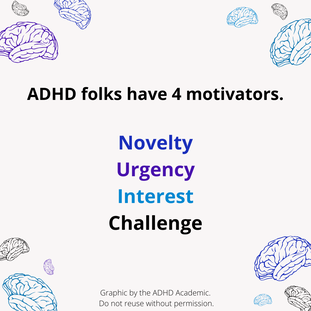
ADHD folks have 4 motivators. Novelty. Urgency. Interest. Challenge. Graphic by the ADHD Academic. Do not reuse without permission.
ADHD folks have difficulty writing for a few reasons: motivating ourselves to do boring tasks is an epic battle, organizing our ten million creative and connected thoughts is a marathon unlike any other, and focusing on a single task, idea, or paragraph isn't something our brains are designed to do.

We are motivated by urgency, interest, challenge, and novelty and I find it's helpful to remember this even when motivation isn't my problem. For example, maybe I can organize my thoughts better if I write an outline but work backwards. The challenge of working backwards makes the task more fun while helping me organize myself. Working with my ADHD rather than against it always works better for me.

Organizing

  • Before you begin writing, create headings and subheadings in your document to help organize everything. You can do this for the entire paper, but you can also do this by section. For example, if you haven't written your discussion yet, make headings and subheadings that you delete later.
  • Before you begin writing, create a slideshow with intro, methods, results, etc. and sketch out the main points you want or need to include for each.
  • If you're stuck, you can still create a slideshow, even if you're never going to present this work. Using figures and slides automatically breaks things down. Switching the format to something new can also motivate us to rethink our structure.
  • Print out your work and use the floor to organize everything. Have everything in front of you. You're less likely to forget something or miss it if you take over a single room in your house or an empty classroom in the history building for the afternoon. Use the time and space wisely.
  • Put main ideas on sticky notes or note cards. Color code by themes. Use stickers or markers to identify topics, connecting ideas, themes, etc.
  • Within your document, color code to identify themes and related ideas. You may realize you have a section in the front that has three distinct main ideas and needs to be broken down or you may determine that you discuss theme one towards the end of your paper except for this one paragraph at the start.
  • Use software and tools like Trello, Jira, Scrivener, MindMeister and other project management and mind mapping tools to get organized. Try different ones. Go back to ones you haven't used in a while. We get bored easily, and something old might be new again.
  • Think of your paper like the last good book you read. What's the story line? What's the beginning, the middle, and the end? What do readers need to know first?

Read More
1 Comment
<<Previous

    Categories

    All
    Ableism
    Accommodations
    ADA
    ADHD 101
    Boredom
    Coursework
    Disability Office
    Disability Rights
    Disclosing Accommodations
    Focusing
    Funding And Scholarships
    Graduate Students
    Lectures
    Mentorship
    Motivation
    Organization
    Procrastination
    Registering With The Disability Office
    Remote Learning
    RSD
    Self Advocating
    Student Rights
    Studying
    Support Groups
    Undergraduate Students
    Writing

    Author

    There's a reason theADHDAcademic is an anonymous account and there's a reason why this website will remain anonymous.  That said, there are some basics it might be helpful to know about me:

    I am white.
    I am a cis-female.
    I am based in the United States.

    ​
    I wasn't diagnosed with ADHD (mixed) until my last year as an undergraduate, just a few months before I graduated.

    DISCLAIMER: I am not a medical professional or a lawyer of any kind. All text, graphics, and content on this website are for educational purposes only. Any and all content should not be substituted for medical or legal advice. Although I strive to provide the most accurate, current, and scientifically sound information, content should never be substituted for professional advice. Always consult a medical and/or legal professional before making any decisions. Links are provided only for reference and do not necessarily imply endorsement. ​
Powered by Create your own unique website with customizable templates.
