the ADHD Academic
  • Home
  • About
    • Glossary
    • Contact
  • ADHD
    • ADHD Fundamentals
    • ADHD in Adults
    • Misconceptions
    • Race, culture, and ADHD
    • More
  • Learning
    • Learning & ADHD blog posts
  • Teaching
    • Teaching & ADHD blog posts
  • Other bits
  • Home
  • About
    • Glossary
    • Contact
  • ADHD
    • ADHD Fundamentals
    • ADHD in Adults
    • Misconceptions
    • Race, culture, and ADHD
    • More
  • Learning
    • Learning & ADHD blog posts
  • Teaching
    • Teaching & ADHD blog posts
  • Other bits

Learning when you have ADHD

Writing tips for those who can't organize, focus, and motivate

1/25/2022

1 Comment


Five sentence summary

Problems with organizing, focusing, and motivation can all make writing a struggle. By working with our brains rather than against them and understanding what motivates us, we can remove some of the barriers and write with less frustration.
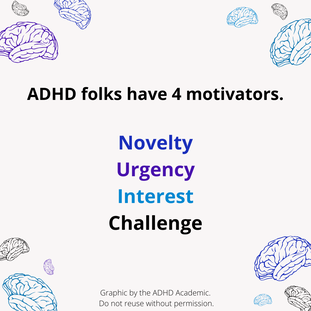
ADHD folks have 4 motivators. Novelty. Urgency. Interest. Challenge. Graphic by the ADHD Academic. Do not reuse without permission.
ADHD folks have difficulty writing for a few reasons: motivating ourselves to do boring tasks is an epic battle, organizing our ten million creative and connected thoughts is a marathon unlike any other, and focusing on a single task, idea, or paragraph isn't something our brains are designed to do.

We are motivated by urgency, interest, challenge, and novelty and I find it's helpful to remember this even when motivation isn't my problem. For example, maybe I can organize my thoughts better if I write an outline but work backwards. The challenge of working backwards makes the task more fun while helping me organize myself. Working with my ADHD rather than against it always works better for me.

Organizing

  • Before you begin writing, create headings and subheadings in your document to help organize everything. You can do this for the entire paper, but you can also do this by section. For example, if you haven't written your discussion yet, make headings and subheadings that you delete later.
  • Before you begin writing, create a slideshow with intro, methods, results, etc. and sketch out the main points you want or need to include for each.
  • If you're stuck, you can still create a slideshow, even if you're never going to present this work. Using figures and slides automatically breaks things down. Switching the format to something new can also motivate us to rethink our structure.
  • Print out your work and use the floor to organize everything. Have everything in front of you. You're less likely to forget something or miss it if you take over a single room in your house or an empty classroom in the history building for the afternoon. Use the time and space wisely.
  • Put main ideas on sticky notes or note cards. Color code by themes. Use stickers or markers to identify topics, connecting ideas, themes, etc.
  • Within your document, color code to identify themes and related ideas. You may realize you have a section in the front that has three distinct main ideas and needs to be broken down or you may determine that you discuss theme one towards the end of your paper except for this one paragraph at the start.
  • Use software and tools like Trello, Jira, Scrivener, MindMeister and other project management and mind mapping tools to get organized. Try different ones. Go back to ones you haven't used in a while. We get bored easily, and something old might be new again.
  • Think of your paper like the last good book you read. What's the story line? What's the beginning, the middle, and the end? What do readers need to know first?

Focusing

  • Create conditions that are more likely to lead to hyperfocus by blocking off an entire evening or afternoon where you do not answer your phone, do not schedule any meetings, do not open that office door, etc. Set limits and respect them. Lie and say you're going to be in a time-sensitive, crucial meeting if you need to.
  • Adjust your environment to work for your senses. Try noise-canceling headphones, put a TV show or a podcast on for background noise, find a YouTube channel with eight hours of ocean waves or other white noise, and create the auditory conditions you need.
  • Ensure you're properly hydrated and fed. If you're already struggling to focus and then five minutes after you've set yourself up for success you're feeling parched, you're not going to last long.
  • Journal or do some sort of brain dump where you get everything out. Whether you write it on paper or do a voice recording, spill all of your thoughts, the deadlines you're worried about, the ideas you can't forget, and whatever else is on your mind before you begin to write. Allocate however long you think you'll need, ten minutes or two, and just dump everything out. It may also be helpful to keep this list or recording available as you write, in case additional worries or thoughts come up and you want to record them and move on.
  • Solidify what you need to write. When you read a long paper, you don't necessarily read every line (or I seriously hope you don't). You read to answer certain questions. What questions does your audience still need answered? Instead of writing whole paragraphs, try writing a list or bullet points.
  • The Pomodoro method works for some folks: set a timer for 25 minutes and work the entire time. When the timer goes off, you give yourself a five minute break. Repeat. After you've spent 60 minutes on the task, take a longer (20 minute) break.
  • Try getting some physical activity. A quick walk around the block, jumping jacks, running to drop something off at the mail, or other movement that gets your heart rate up is shown to help focus.
  • Try distinguishing the writing tasks that you can do in-between other meetings versus the writing tasks that require sustained focusing. Don't try and write the discussion section of a paper on a day where you have multiple classes and interruptions. That's a task better suited for an entire evening with the cell phone turned off. Instead, on days when you know you can only work for shorter periods of time, try proof-reading or updating your citations. Categorize the work you have remaining and document it somewhere so you can easily pull from these categories as needed.
  • Related to above, write yourself notes, highlight text, and  do whatever you need to give yourself signposts on the map that is your paper. That way, when you're interrupted, you know exactly where you need to pick off. Don't be afraid to ask someone to hold on for a minute as you make a note to yourself.
  • Work with your ADHD (and don't forget that your ADHD is your ADHD). If you've set yourself up for success, blocked off the time, are playing the right music, know what your goal is for the day, did a long journal session, but your brain still is wandering, try again some other time. Yes, really. Sometimes the focus just isn't there. We do everything right. We set ourselves up for success. Rather than waste energy stressing about the work you're not doing or trying to make a circle fit into a square hole, just move on to something else. It happens and it's okay!

Motivating

  • Give yourself the challenge of don't edit, just write. You can't press the delete button (okay maybe for typos and such) and you are not allowed to remove even the worst ideas. Perhaps set a time limit  of how long you're going to do this for, but the added challenge may be enough to make it fun.
  • Go write in public or use an online virtual shared workspace. Being around other folks sometimes motivates us to get to work or get busy. Turning off your wifi and turning on other apps designed for focusing might also tip us over into "writing mode."
  • If you're stuck on a particular section or topic, change something about the writing process. Try making a power point presentation of it, a sketchnote, or try walking and talking and using a speech-to-text app. It might sound lame or obvious, but by thinking about the same problem in a new way, it's slightly more interesting and exciting. What if you made a table? What if this was a figure? What if it was a flowchart? A poem? A song? What if you made a visual abstract for this section? Or an infographic? Or a poster? It doesn't have to go in the final paper, but it's enough fun to get you working in that general direction.
  • We're motivated by challenges and competitions, so see if you can get one going with a colleague or a friend. Your friend doesn't even need to also be writing; whoever accomplishes these two tasks on their to-do list first has to buy beer Friday night or whatever. Agree upon the terms and set either a great reward or some sort of awful consequence (you lose, you clean out the department fridge).
  • On a similar note as above, using social media can also be the kick in the pants we need. It can be a form of accountability. Post your goal on Twitter, and then post whether or not you met it.

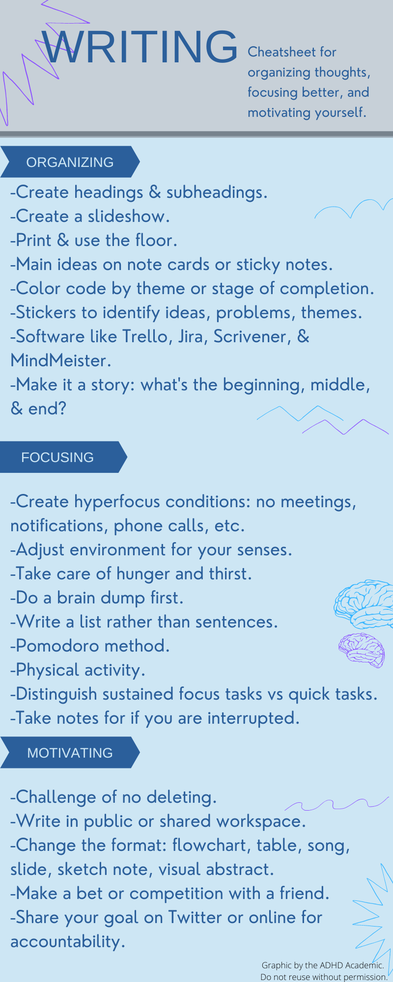
Writing when you have ADHD cheatsheet

Writing. Cheatsheet for organizing thoughts, focusing better, and motivating yourself. Organizing subheading. -Create headings & subheadings. -Create a slideshow. -Print & use the floor. -Main ideas on note cards or sticky notes. -Color code by theme or stage of completion. -Stickers to identify ideas, problems, themes. -Software like Trello, Jira, Scrivener, & MindMeister. -Make it a story: what's the beginning, middle, & end? Focusing subheading. -Create hyperfocus conditions: no meetings, notifications, phone calls, etc. -Adjust environment for your senses. -Take care of hunger and thirst. -Do a brain dump first. -Write a list rather than sentences. -Pomodoro method. -Physical activity. -Distinguish sustained focus tasks vs quick tasks. -Take notes for if you are interrupted. Motivating subheading. -Challenge of no deleting. -Write in public or shared workspace. -Change the format: flowchart, table, song, slide, sketch note, visual abstract. -Make a bet or competition with a friend. -Share your goal on Twitter or online for accountability. Graphic by the ADHD Academic. Do not reuse without permission.

For organizing, focusing, and motivating, you can always use urgency

In the worst case scenario, when you're really unmotivated, could not care less, focus is never going to stick even with all of the ADHD meds in the world, you can always rely on urgency (also known as stress, also known as fear because, "Oh my gosh this is due in 12 hours!"). Urgency can be dangerous but it can also be effective. If you really can't get yourself to write something, wait until the last minute, but be smart about it.
  • Make a list of what absolutely needs to get done and then arrange your list items in order of priority. If the house is on fire, you are not going to mow the lawn. You're going to save the kids and grab the dog. Might grab important documents if you have time. Then maybe there are some wedding photos you want. What in your writing is the dog? What are the wedding photos? What's the lawn?
  • Schedule in time for rest. Using urgency is exhausting and it's not going to be fun, but if you schedule in time for recovery afterwards, it might be manageable. Don't use a terrifying deadline to write at the last minute and then head to some daylong workshop.

Key points:

  • Use novelty, urgency, interest, and challenge when you get stuck.
  • Try presenting the concept in a different way: create a PowerPoint, try an infographic, speak your thoughts and use a speech-to-text app, tweet your main ideas even. Reframing the issue or the topic makes it new and potentially interesting.
  • Create conditions for hyperfocus.
  • Recognize the writing tasks best suited for instances when you have the entire day to write versus instances when you only have a few minutes here and there to work.
  • Work with your ADHD rather than against it. Some days the focus just won't happen and this is normal.
             
1 Comment
online text extractor link
3/6/2026 12:18:54 am

I needed a fast solution and the online text extractor worked perfectly. No downloads were needed, and it processed my images in seconds. The accuracy was better than I expected for an online tool. Definitely convenient for quick text extraction on the go.

Reply


Leave a Reply.

    Categories

    All
    Ableism
    Accommodations
    ADA
    ADHD 101
    Boredom
    Coursework
    Disability Office
    Disability Rights
    Disclosing Accommodations
    Focusing
    Funding And Scholarships
    Graduate Students
    Lectures
    Mentorship
    Motivation
    Organization
    Procrastination
    Registering With The Disability Office
    Remote Learning
    RSD
    Self Advocating
    Student Rights
    Studying
    Support Groups
    Undergraduate Students
    Writing

    Author

    There's a reason theADHDAcademic is an anonymous account and there's a reason why this website will remain anonymous.  That said, there are some basics it might be helpful to know about me:

    I am white.
    I am a cis-female.
    I am based in the United States.

    ​
    I wasn't diagnosed with ADHD (mixed) until my last year as an undergraduate, just a few months before I graduated.

    DISCLAIMER: I am not a medical professional or a lawyer of any kind. All text, graphics, and content on this website are for educational purposes only. Any and all content should not be substituted for medical or legal advice. Although I strive to provide the most accurate, current, and scientifically sound information, content should never be substituted for professional advice. Always consult a medical and/or legal professional before making any decisions. Links are provided only for reference and do not necessarily imply endorsement. ​
Powered by Create your own unique website with customizable templates.