the ADHD Academic
  • Home
  • About
    • Glossary
    • Contact
  • ADHD
    • ADHD Fundamentals
    • ADHD in Adults
    • Misconceptions
    • Race, culture, and ADHD
    • More
  • Learning
    • Learning & ADHD blog posts
  • Teaching
    • Teaching & ADHD blog posts
  • Other bits
  • Home
  • About
    • Glossary
    • Contact
  • ADHD
    • ADHD Fundamentals
    • ADHD in Adults
    • Misconceptions
    • Race, culture, and ADHD
    • More
  • Learning
    • Learning & ADHD blog posts
  • Teaching
    • Teaching & ADHD blog posts
  • Other bits

Learning when you have ADHD

Triage, or a method for visualizing priorities when overwhelmed

12/11/2023

1 Comment


Five sentence summary

I'm sharing a tool or visualization method I use when I am totally overwhelmed and having trouble prioritizing. It relies on two ideas: external pressures indicating the importance of the task and internal pressures making the task hard to do.
Prioritizing is an executive function, which means it is something ADHD folks struggle with. This includes adults. If you're overwhelmed with the million little things you need to do before you turn in a final paper or before you finish a final presentation, trying making something like a triage table.  I created this as a tool to help students studying for final exams, but it quickly became obvious that it could be used for anyone who feels overwhelmed and immobilized by that feeling (I use it).

On one side you have what is essentially the importance or urgency of the activity. This the heading across the top of the columns. And on the other side, across the rows the rows you have your own internal struggle, whether you're struggling because you're not interested in the task or because you're paralyzed with anxiety, it's your struggle. Both rows and columns only have three options : high, moderate, and low. Keep it simple. Take your list of tasks, steps, or study topics and place them in the corresponding cells.
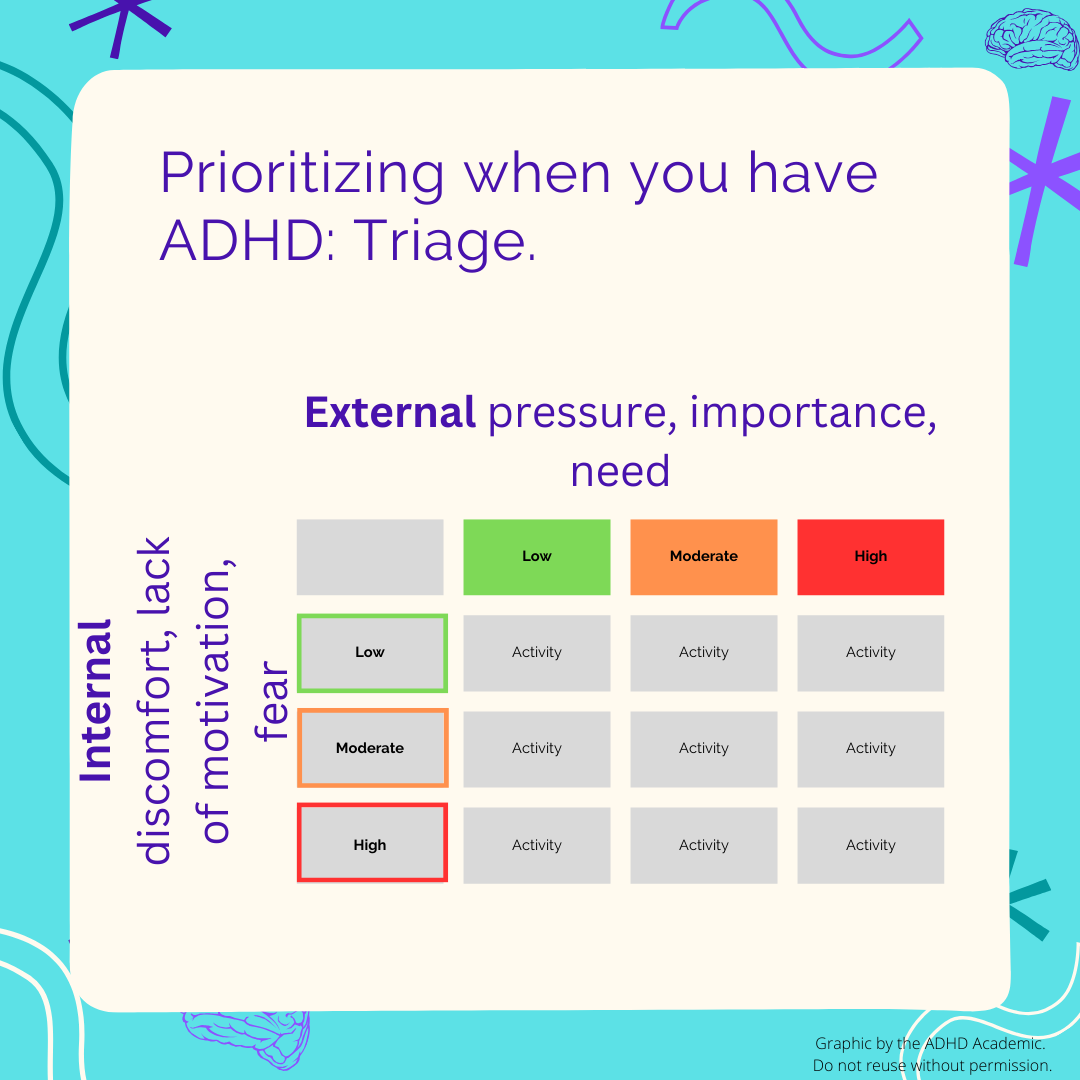
Prioritizing when you have ADHD: Triage.  Table with column title reading,
When you start working, your goal is to stay in the solid red (see the image below). You want to work on the most urgent and important items first: the items you can't forget or can't exclude. Use the outline color or left hand side as a secondary guide. Have an exam you're really nervous for? Start with an activity with low internal discomfort but high external importance. If you want to start your day accomplishing one of your hardest tasks first, start in the bottom right-hand corner. If you're feeling really unmotivated and didn't sleep well, start in the top right. Steer clear of those activities that are solid green until you've accomplished all of the solid red ones. Try not to move to any solid orange activities until you've finished all of the solid red tasks, but all of this is subjective and dependent individual energy, environment, and so forth. Some days it may be all solid green items. Use the reverse low bar limbo if you can't get yourself to start.

The examples below have one activity per cell, but you might very well have three tasks that are high priority and cause you a high level of internal discomfort and zero tasks in some other cells.

If red stresses you out, change the colors to whatever works and makes sense for you. 

Creating a table like this forces me to prioritize. Color coding makes it easier for my brain to process. I used Canva to make these figures but you can use Google Sheets or Excel or even make a Power Point slide and adjust as needed.
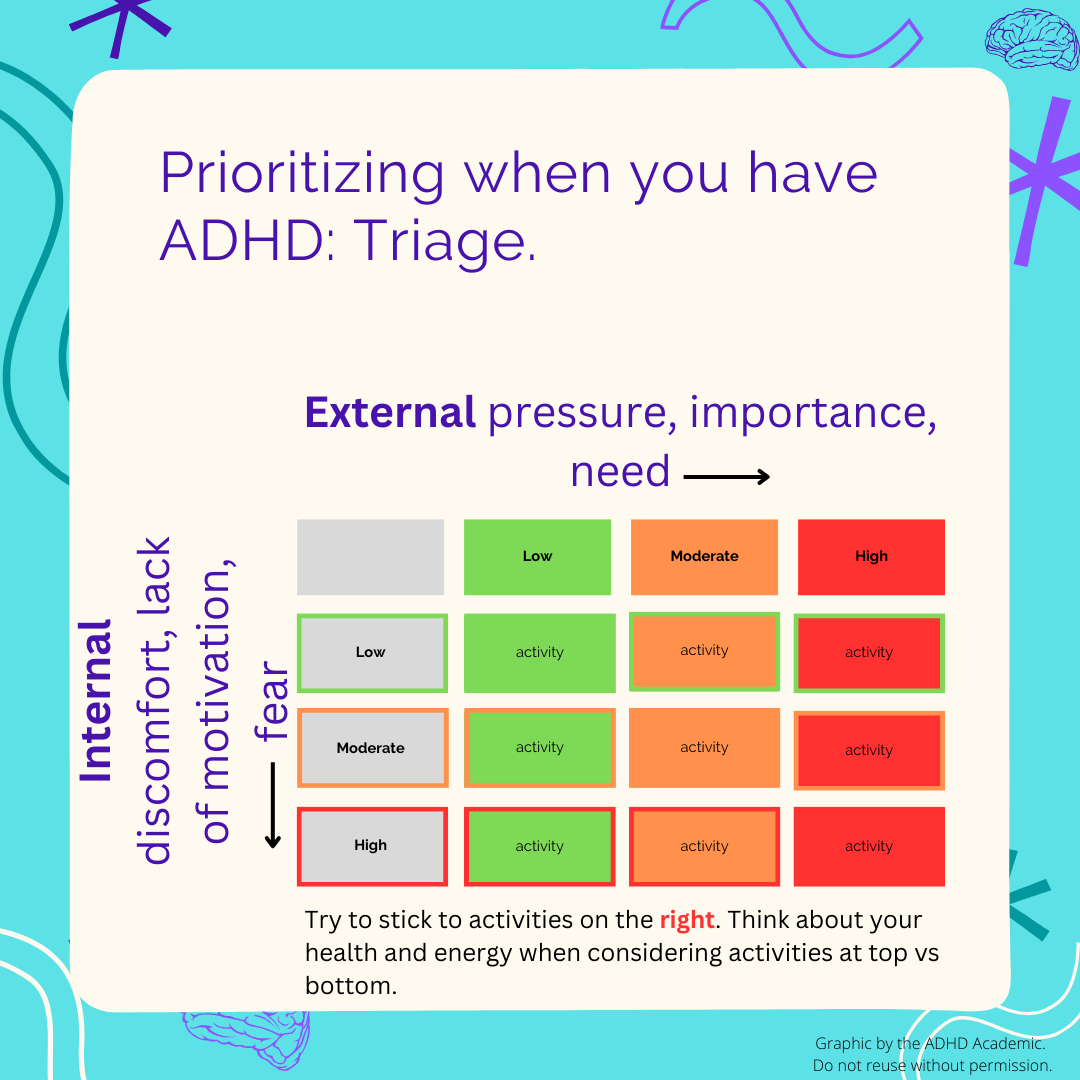
Prioritizing when you have ADHD: Triage.  Table with column title reading,

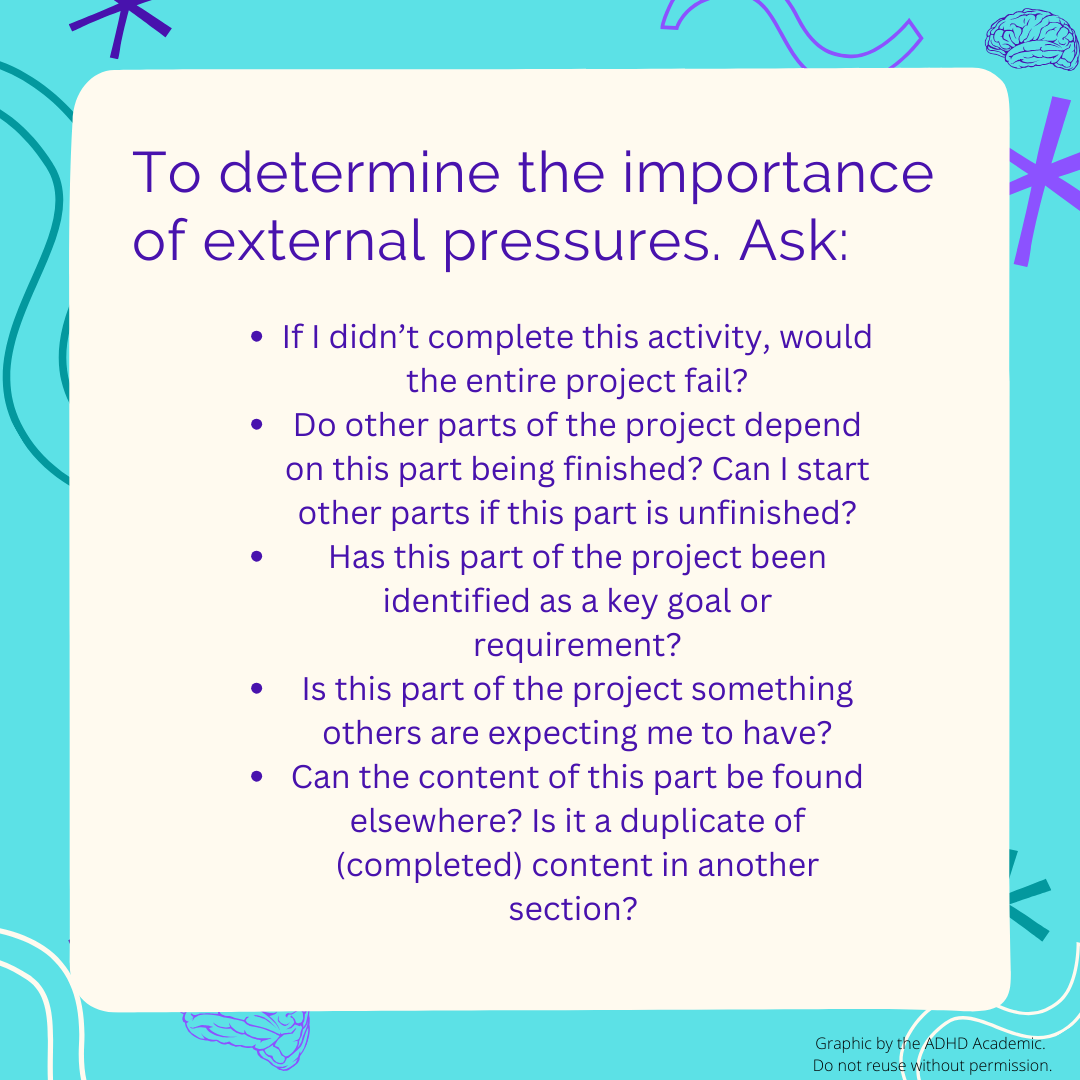
How can I determine if a task is important or not?

When identifying if something is important or not, ask yourself the questions on the image below. Do other parts of the project depend on this part? If you can't do steps 3 and 4 of the take home exam without doing step 1a, finish 1a. What would happen if you didn't finish the conclusion and turned in the paper without it? Well, your grade will likely decrease but it's not the same as not creating a fully defined thesis question, especially if that was specified as one of the key requirements.

Students studying for an exam, see the triage table in the blog post on studying. It replaces external pressure with likelihood the topic will be on the exam. Internal discomfort is replaced with your own comfort level with the topic.
Picture
I'm sure there are other flow charts and tools out there that operate on a similar premise. There are probably apps as well. Please feel free to share what works for you in the comments!

Key points

  • Balance the external pressures with your internal discomfort, with the goal of accomplishing the most important tasks first.
  • This tool helps me visualize my to-do list when I'm feeling overwhelmed and like I have too many options or don't know where to start.
  • Create your own table and make the changes that work for you; switch the colors if red stresses you out, create rules, such as one table per project with all activities scored relative to one another rather than absolutely.
  • The goal is to prioritize topics based on the external pressures, the importance of the task, and the need. This might not be possible some days, and it's important to recognize your own energy levels and any constraints.
1 Comment

Studying tips

3/29/2023

1 Comment


Five sentence summary

Studying requires several executive function skills plus focusing for extended periods of time, so ADHD folks often have trouble. There are general best practices that will help you regardless of whether or not you have ADHD and ones that are designed specifically for ADHD folks separated into organizing, focusing, and motivating. Finally, active studying is much more effective than passive studying, and the chances of feeling bored are much lower.

General best practices

ADHD brains are different but in some ways we are very much the same. Sleep improves our memory just like everyone else. Exercising regularly also is shown to improve our memory and overall well-being. Dehydrated brains don't work well, including dehydrated ADHD brains. Making personal connections to the material we need to study helps us but it also helps everyone else. These are the tips that are almost guaranteed to apply no matter what you are trying to study.

  1. Use shorter study sessions and space them out over time. There's lots of science behind this (see here, here, and here). Do multiple sessions over time with sleep in-between. We need sleep to commit material to our long-term memory, so don't undervalue sleep!
  2. Don't fall into the "fallacy of familiarity" or the idea that you know something just because it registers as familiar. Combine active studying techniques with passive techniques. Don't only reread your textbook or reread your notes: summarize a chapter from memory, listen to a lecture for 20 minutes and then re-frame the ideas in your own words.
  3. Don't force yourself to study the same topic for too long. When you feel your attention wavering, switch to a new topic or take a break. There's only so much the brain can take.
  4. Drink water.
  5. Connect any new material to material you already understand or something meaningful to you. We remember what is meaningful. Use analogies to connect the new or boring material to a topic of interest, or your personal life, or your favorite sport or hobby.
  6. Make note of your attention and your studying techniques. Your ADHD is your ADHD and you're the best person to understand it. What tips work for you? What time of day do you focus best? What study groups have been helpful and which have not? Get to know your ADHD brain as best you can and look for patterns. We might struggle with consistency, but there will likely be patterns.

Read More
1 Comment

Writing tips for those who can't organize, focus, and motivate

1/25/2022

1 Comment


Five sentence summary

Problems with organizing, focusing, and motivation can all make writing a struggle. By working with our brains rather than against them and understanding what motivates us, we can remove some of the barriers and write with less frustration.
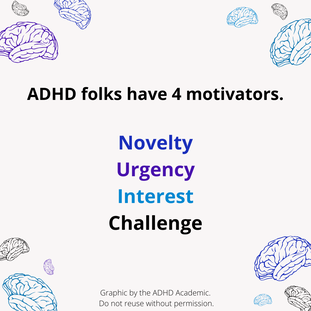
ADHD folks have 4 motivators. Novelty. Urgency. Interest. Challenge. Graphic by the ADHD Academic. Do not reuse without permission.
ADHD folks have difficulty writing for a few reasons: motivating ourselves to do boring tasks is an epic battle, organizing our ten million creative and connected thoughts is a marathon unlike any other, and focusing on a single task, idea, or paragraph isn't something our brains are designed to do.

We are motivated by urgency, interest, challenge, and novelty and I find it's helpful to remember this even when motivation isn't my problem. For example, maybe I can organize my thoughts better if I write an outline but work backwards. The challenge of working backwards makes the task more fun while helping me organize myself. Working with my ADHD rather than against it always works better for me.

Organizing

  • Before you begin writing, create headings and subheadings in your document to help organize everything. You can do this for the entire paper, but you can also do this by section. For example, if you haven't written your discussion yet, make headings and subheadings that you delete later.
  • Before you begin writing, create a slideshow with intro, methods, results, etc. and sketch out the main points you want or need to include for each.
  • If you're stuck, you can still create a slideshow, even if you're never going to present this work. Using figures and slides automatically breaks things down. Switching the format to something new can also motivate us to rethink our structure.
  • Print out your work and use the floor to organize everything. Have everything in front of you. You're less likely to forget something or miss it if you take over a single room in your house or an empty classroom in the history building for the afternoon. Use the time and space wisely.
  • Put main ideas on sticky notes or note cards. Color code by themes. Use stickers or markers to identify topics, connecting ideas, themes, etc.
  • Within your document, color code to identify themes and related ideas. You may realize you have a section in the front that has three distinct main ideas and needs to be broken down or you may determine that you discuss theme one towards the end of your paper except for this one paragraph at the start.
  • Use software and tools like Trello, Jira, Scrivener, MindMeister and other project management and mind mapping tools to get organized. Try different ones. Go back to ones you haven't used in a while. We get bored easily, and something old might be new again.
  • Think of your paper like the last good book you read. What's the story line? What's the beginning, the middle, and the end? What do readers need to know first?

Read More
1 Comment
<<Previous

    Categories

    All
    Ableism
    Accommodations
    ADA
    ADHD 101
    Boredom
    Coursework
    Disability Office
    Disability Rights
    Disclosing Accommodations
    Focusing
    Funding And Scholarships
    Graduate Students
    Lectures
    Mentorship
    Motivation
    Organization
    Procrastination
    Registering With The Disability Office
    Remote Learning
    RSD
    Self Advocating
    Student Rights
    Studying
    Support Groups
    Undergraduate Students
    Writing

    Author

    There's a reason theADHDAcademic is an anonymous account and there's a reason why this website will remain anonymous.  That said, there are some basics it might be helpful to know about me:

    I am white.
    I am a cis-female.
    I am based in the United States.

    ​
    I wasn't diagnosed with ADHD (mixed) until my last year as an undergraduate, just a few months before I graduated.

    DISCLAIMER: I am not a medical professional or a lawyer of any kind. All text, graphics, and content on this website are for educational purposes only. Any and all content should not be substituted for medical or legal advice. Although I strive to provide the most accurate, current, and scientifically sound information, content should never be substituted for professional advice. Always consult a medical and/or legal professional before making any decisions. Links are provided only for reference and do not necessarily imply endorsement. ​
Powered by Create your own unique website with customizable templates.
